
Interview With Bandai Namco Development Team Members Who Worked on the original TIME CRISIS.

Hirofumi Kami Bandai Namco Studios Inc.
Joined in NAMCO LIMITED(currently Bandai Namco Entertainment Inc.) in1989. After experiencing in the arcade operations, he transferred to the development division. He has been involved in developing a variety of arcade and home titles, serving as director and producer. Notable development titles include:
· Time Crisis (1996)
· Final Furlong (1997)
· Kaitou Rousseau (2006)
· Deadstorm Pirates (2010)

Shinya Yamada Bandai Namco Entertainment Inc.
Joined NAMCO LIMITED(currently Bandai Namco Entertainment Inc.) in 1990. As a programmer, he was involved in the development of large-scale immersive arcade games and both arcade and home console gun shooting games (Currently, he works in a department that supports data analysis for game titles, responsible for building infrastructure). Notable works include Galaxian³ (1992), Time Crisis (1996), and Kotoba no Puzzle: Mojipittan (2004).
Q. Tassei Denki (TD)
Thank you for finding time in your busy schedule to speak with us today. We’ve been really looking forward to meeting both of you, who were involved in the development of TIME CRISIS! It’s an honor. Let’s get started—how did TIME CRISIS come into being?
A. Kami: Bandai Namco Studios (BNS)
Back then, arcade games were in their golden era. We were releasing a lot of new ideas, RIDGE RACER, ALPINE RACER, and so on. Gun shooting games had already become a standard genre starting from STEEL GUNNER, and Namco was releasing a new one almost every year.
A. Yamada: Bandai Namco Entertainment (BNE)
It was around the time when the PlayStation was just about to be released, so if you wanted to play something really exciting, you had to go to the arcade. Within the dev team, there was an intense desire to push technical limits and show off amazing visuals, it was a really passionate time.

A. Kami: BNS
Polygonal CG tech was just emerging. First came WINNING RUN, then texture-mapping capabilities were added, leading to RIDGE RACER, and then AIR COMBAT, which became ACE COMBAT. Following that trend, we began wondering: what would it be like to make a gun game in polygons? The visual expression would be more realistic, so we had to think hard about how to approach it.
A. Yamada: BNE
Kami-san was definitely in the “polygon gun game” camp. I had just made the 2D game POINT BLANK and felt frustrated—it ended up being just a shooting gallery game. Quick draw, precise aiming, rapid fire—those four mechanics are what make a gun game fun. I had included all of them, but there was no narrative. That frustration made me want to create something that could really leave an impact. That’s how the two of us got “in sync” We said, “Let’s make something like that together”.
Q. TD
Speaking of polygons, were there any technical limitations you faced using that technology at the time?
A. Yamada: BNE
It was nothing but limitations! (laughs)

A. Kami: BNS
Even though the arcade boards were cutting-edge at the time, the number of polygons they could output was limited. While aircraft and cars were relatively easy to render, it was much harder to represent human characters due to polygon constraints. You’d see fighting games with just two characters and very simple backgrounds.
TIME CRISIS, on the other hand, featured fully polygonal environments and 5–6 enemies on screen at once. It required way more polygons than we had. In our internal reports, we even wrote things like, “This might be too difficult to pull off.” We warned of the risks but requested approval with the promise we’d do everything we could to make it happen.
A. Yamada: BNE
So you hedged your bets like that! (laughs) Well, we made up for the polygon shortage with game system design. Since it was a rail shooter, the player’s path was predetermined. That meant we didn’t need to render areas outside the player’s view, so we could allocate more polygons to characters. You can’t make a gun game exciting with just three enemies—you need at least six. Ideally, we wanted more camera movement and zoom effects, but we had to cut those to prioritize character rendering.
A. Kami: BNS
We initially considered implementing hit detection in 3D too, right?
A. Yamada: BNE
Yes, but we had to scrap it. The CPU was only 25MHz, and when it had to handle 3D rendering, character movement, and hit detection all at once, the processing power just wasn’t enough.
A. Kami: BNS
I remember you told me you’d found a more efficient method, and thanks to that, we managed to hit 60fps. You showed me both 30fps and 60fps versions, and the difference was clear. I insisted—we have to go with 60fps.
A. Yamada: BNE
Yeah, that nearly killed me! (laughs) At first, we prioritized rendering more characters, so we were told 30fps would be fine. But I just couldn’t accept the choppiness—so I said no, it must be 60fps. To achieve that, we had to simplify the hit detection to 2D.
Q. TD
Creating something that had never been done before must have been incredibly challenging. Among those innovations, the use of a foot pedal in TIME CRISIS stands out. That must’ve been a big development?
A. Kami: BNS
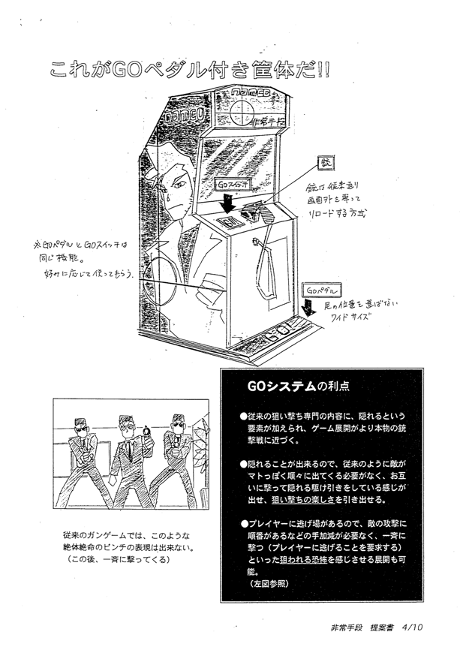
The concept of hiding and emerging was there from the start. I proposed the pedal idea for that, but I didn’t have full confidence, so I also suggested adding a button on the cabinet that would do the same thing.
A. Yamada: BNE
The pedal was something I was really adamant about. When you shoot a gun, you naturally take a stance with one foot forward. I wanted players to experience that physically, so I thought the pedal was the most natural way.
A. Kami: BNS
At the time, most gun games just had you shoot enemies as they appeared, in sequence. That felt lacking to me—something was missing.
A. Yamada: BNE
Exactly. If you're in a shootout, you'd instinctively want to dodge. To simulate the real feeling of shooting, the pedal made more sense. Shooting and dodging needed to be part of the same immersive experience.
A. Kami: BNS
In action films, it’s not just about shooting—there’s thrill in being pinned down or narrowly avoiding danger. We wanted to capture that feeling.
Q. TD
The early design documents and concept sketches for TIME CRISIS are very detailed—it’s impressive how many people contributed to it. How did the protagonist, Richard Miller, come about?

A. Kami: BNS
When I first came up with the idea, the name “Richard Thunder” popped into my head. I even had a working title: Richard Thunder: Emergency Measures. At the time, Japanese releases of Hollywood films typically had kanji subtitles, so I intentionally wanted a Japanese-style title too. I think the character was initially a police officer, but that changed as the project evolved.

A. Yamada: BNE
We made him a secret agent for a reason—we didn’t want a protagonist who enjoyed killing. There were plenty of gun games where you just shoot for fun, but TIME CRISIS was different. The mission was to rescue someone, and shooting a lot wasn't what made it happy. It was a story where saving, not killing, was important, and there was a real narrative.We needed a protagonist with depth and shadows—not someone who just enjoys shooting. That’s why he became an agent.
A. Kami: BNS
Namco games at the time avoided graphic violence and focused on wholesome content. There was some initial debate about whether we should depict shooting realistically. In the end, we added a switch to the arcade board that changed the hit effect color from red to green—to suggest they weren't real humans being shot.
Comment: Tassei Denki (TD)
That’s a truly admirable philosophy from Namco—it left a strong impression on me. In our previous meeting with Mr. Kaku, he mentioned something similar. He said that the in-game “action” represents the idea of: “This is a performance, like filming an action movie—you are playing a role.”
Comment: Kami - Bandai Namco Studio (BNS)
Originally, the command was going to be “GO.” However, when we checked with native English speakers, they felt it was a bit unnatural and suggested “ACTION” instead, which we adopted. As for the name “Richard Thunder,” when we ran it by native speakers, they pointed out it sounded odd. It’s like combining the common first name “Richard” with a last name that literally means “Thunder,” which in Japanese would be akin to naming someone “Raijin Taro”—a bit cheesy.
So, we received several alternative suggestions, held a team vote, and landed on “Richard Lewis.” But we later found out that was the name of a real American comedian. So, in a third and final round of voting, we decided on “Richard Miller.”

Comment: Tassei Denki (TD)
Looking at the materials, it seems not only Richard Miller but also other characters originally had different names.
Comment: Kami - Bandai Namco Studio (BNS)
Wild Dog was originally called “Crazy Dog,” inspired by the popular Japanese band “Crazy Cats.” Rachel was also named Ellen at one point. We shared these names with non-Japanese members in our US office, got their impressions, and received more natural name suggestions from them. We eventually voted within the team to decide. As for “Sherudo Garo,” we kept the original name from the beginning.


Comment: Tassei Denki (TD)
I saw a note from the overseas team saying: “Love the name Garo!” (laughs)It’s great that you were flexible in accepting advice from native speakers. By the way, how was the story for TIME CRISIS created?
A: Yamada: (BNE)
At the time, the core team was three people: Kami handled planning, I did the programming, and Mr. Saito was the designer. We worked together to shape the story and the system. Personally, I was passionate about having a serious storyline. This was because I questioned whether it was truly okay to have a shooting game where enemies appear and it's simply enjoyable to shoot them. I had doubts, or rather, a sense of guilt about creating a game that revels in the act of using a gun, which is a tool for taking lives. That's why I didn't want to make a game where it's fun to shoot and kill, so I suggested making the story heavy, with an ending that makes you think, 'Was this really the right thing to do?' The team understood and embraced that intention.
Q. TD
When in the development process was the story created?
A. Kami: BNS
We first came up with the idea of a gun game using a foot pedal, and then developed the story. I think my original concept pitch was more of a detective theme. Later, as we formed the project team, we discussed what kind of story would suit it. The castle setting came from a technical reason—when applying textures to CG, things like stone and brick textures produce more realistic visuals. That’s why we decided on a castle as the stage.
A. Yamada: BNE
I was hugely inspired by The Castle of Cagliostro. I was also particular about setting it on a small island, because I wanted players to experience the feeling of being in another world and then returning—like a complete story arc. That kind of narrative is exciting, isn’t it?
Q. TD
Looking back now, is there anything you were especially particular about in TIME CRISIS?
A. Yamada: BNE
I believe this was the first game at Namco that incorporated real physics simulation. Before that, there were things like moving necklaces or hair in fighting games, but with TIME CRISIS, everything on screen was calculated with physics. We put a lot of technical effort into making sure everything moved in a way that felt natural, immersive, and believable. Even the way cars stop—calculating friction from braking and so on. It might seem pointless—you could just animate it normally. But for scenes like shooting a mirror, we wanted the glass to shatter from the point of impact, with shards falling based on physics.
Q. TD
That level of detailed physics really shows the passion in every part of the game. From an immersion standpoint, TIME CRISIS feels like watching a movie.
A. Yamada: BNE
I’m glad that feeling came through.
A. Kami: BNS
We consistently aimed to make it cinematic from the start.
Q. TD
What was the atmosphere at Namco during development?
A. Yamada: BNE
It was intense—everyone was passionate and emotional. Work was crazy busy, and we were all working incredibly hard.
A. Kami: BNS
We were young, too. It wasn’t unusual to start work in the afternoon and go until late at night. That doesn’t happen anymore since the company has become more structured. At the time, we had “project rooms”—separate areas just for development staff, where we could arrange desks however we liked. It felt like a school club or circle.
A. Yamada: BNE
Yeah, more like a doujin or indie dev vibe. People gathered because they wanted to. We’d casually ask Kami to revise storyboards if we didn’t like them.We’d also ask tech engineers to write scripts even if it wasn’t their job. They’d grumble, “Yamada-san, you’re too much!”—but in a fun way.
Q. TD
It sounds open-minded and collaborative. Were there any conflicts?
A. Yamada: BNE
Tons! We fought all the time. Someone once casually suggested, “What if the player could change weapons? Like shoot a box and get a machine gun, that’d be fun!”I shot that down immediately: “That’s not what TIME CRISIS is! The protagonist is a special ops agent!”
Q. TD
Haha, a machine gun would have definitely shifted the team’s concept, especially since you emphasized ethics. Namco games often have playful hidden elements—did TIME CRISIS have anything like that, like hidden commands in BATTLE CITY?
A. Kami: BNS
Not that I know of.
A. Yamada: BNE
We secretly added a feature: if you hit 40 targets in a row (including destructible objects, not just enemies), you’d recover one life.* QA flagged it as a bug since it wasn’t in the specs.
(*Note: Shooting 40 consecutive targets restores one life.)
Q. TD
Was TIME CRISIS handled differently compared to other Namco projects at the time?
A. Yamada: BNE
Yes. Namco was already divided into departments: planning would come up with ideas, visuals handled art, and programming did the code. But for some reason, TIME CRISIS was done in a troika system with planning, programming, and visuals working together. I don’t think any other project was structured that way. It became a kind of culture, and the next TIME CRISIS followed the same method. Our vibe was uniquely enthusiastic—it didn’t feel like making a game in the usual sense.
Q. TD
When you first proposed the concept for TIME CRISIS, was there any internal debate?
A. Kami: BNS
When I brought the concept to my boss at the time—Mr. Iwatani*—he liked it right away. Actually, the next project I worked on, a horse racing game, was the one that ran into more challenges. (*Toru Iwatani, known as the creator of PAC-MAN)
Q. TD
Were there any features or ideas you wanted to include but couldn’t due to limitations at the time?
A. Kami: BNS
As the planner, I voiced what I wanted to do, and the project team helped realize it. From mechanisms to controller feel, accuracy, and even the blowback system—I had a lot of requests.
A. Yamada: BNE
I really wanted the blowback to be stronger—to give a more satisfying recoil. And I wanted branching story paths, but the biggest thing I gave up on early was enemy AI. Enemy behavior was controlled by scripts—like fleeing if you shoot nearby, or approaching if you’re far away. That worked, but it was a compromise. What I truly wanted was for them to behave more autonomously and naturally, like real enemies, but with limited memory and processing power back then, we just couldn’t make it happen.
Q. TD
The protagonist, Richard Miller, doesn’t speak and expresses everything through facial expressions. Was that intentional?
A. Kami: BNS
Yes, it was intentional. We wanted players to sync with the protagonist and feel like they were the main character.
A. Yamada: BNE
It’s quite a difficult game, so players are bound to struggle before clearing it. The frustration, the joy of clearing—it’s all felt by the player, not by Richard. Since those emotions are internal to the player, we chose not to give Richard any dialogue.
Q. TD
That perspective really reflects Namco’s philosophy. I'm glad to hear that behind-the-scenes insight. Was Wild Dog inspired by anything in particular?
A. Kami: BNS
At the time, I was watching a lot of movies, and I vaguely remember thinking that making the villain East Asian could be interesting. I do think we made him older than my original concept, but I honestly don’t remember what the exact inspiration was.
A. Yamada: BNE
We were probably influenced by things like A Better Tomorrow or Lethal Weapon. What we absolutely wanted was a clearly evil character—one that the player would want to take down as Richard. We made him feel really “evil” through his clothing, his actions, everything.
Q. TD
When I first played, I thought Sherudo Garo was the final boss, but then there was an even stronger enemy. Was that structure planned from the start?
A. Kami: BNS
I think that was intentional. In our early storyboards, the plan was to defeat Sherudo in Stage 2 and rescue Rachel, then escape together in Stage 3. But things changed, and she ends up not coming with you. So the narrative misleads you into thinking you’ve finished the game at Stage 2, only to hit a twist—that’s something we wanted.
A. Yamada: BNE
Yes, we definitely wanted that twist.
Q. TD
The game features a country called Sercia. What real-world region did you have in mind?
A. Yamada: BNE
We didn’t imagine any specific country, but geographically speaking, somewhere like the Mediterranean or Europe.
Q. TD
With today’s technology, a remake with significant upgrades could be possible. If that were to happen, what do you hope would be preserved?
A. Yamada: BNE
I’d want them to keep the message - what the game tries to leave in the player’s heart.
What we embedded in TIME CRISIS was a question: “Is it really right to kill someone with a gun in the name of justice?”
That’s a message you don’t see in many modern games. There are tons of FPS titles out there, but most of them actively encourage shooting and killing.
TIME CRISIS is different. We wanted players to finish the game wondering,“Was it really okay to shoot so much?”, I hope players interpret that question in their own way.
Q. TD
That really came through in the ending—rescuing Rachel and carrying her to the helicopter. You saved her, but it didn’t feel entirely happy. It felt like an invitation to think for yourself.
A. Yamada: BNE
Exactly. That’s what we most wanted to convey.
A. Kami: BNS
Modern FPS games can depict realistic shooting, but TIME CRISIS is about enjoying the feeling of being in a movie. It’s not about realism—it’s about cinematic moments. For the remake, I hope they keep that “hero” feeling—where the enemy bullets always miss, but yours always land. That’s the experience we wanted players to enjoy.
Q. TD
Do you two still play games today?
A. Kami: BNS
These days, I only casually enjoy titles that catch my interest.
Q. Yamada: BNE
I barely have time—about the only one I play is THE IDOLM@STER.
Q. TD
There are many modern games, but I still find retro games more enjoyable.
A. Yamada: BNE
That might be due to differences in game systems. Back then, we often built contradictions into gameplay. For example, in TIME CRISIS, you want to shoot but don’t want to get shot—so you hide. But if you hide too long, you run out of time, so players are constantly resolving internal contradictions. Modern games tend to be efficiency-driven. But we designed TIME CRISIS to create emotional and narrative conflict in a short play session—like thinking you can save someone but failing to do so.
A. Kami: BNS
That reminds me—that I wanted to express the fear and conflict of not just shooting unilaterally, but also being targeted and shot at by enemies. That's why we implemented a cover mechanic. However, we didn't want players to just hide all the time because they were afraid of being shot, so we added a time limit. Since there needed to be a reason for the time limit, we came up with the story of Time Crisis needing to be resolved by evening. That’s what led to the title TIME CRISIS, but when we took it to the arcade, players didn’t really hide! We designed the game assuming they’d duck and cover—but they just ran into the bullets. I remember thinking “Oh no!” while standing behind them, silently yelling “Hide!”


Q. TD
When was the title TIME CRISIS decided?
A. Kami: BNS
Around the same time as the character names. We had several options and voted. “Richard Thunder” was my top pick, and we had a lot of names with “Thunder” in them. “Deadline” was another. TIME CRISIS wasn’t in the first round of options—it came up after we got feedback from native speakers and was chosen by team vote.
Q. TD
Nowadays you can patch bugs via the internet, but back then that wasn’t possible. Were there any bugs after launch?
A. Yamada: BNE
Honestly—none. We fixed everything before release. We even developed tools to display bugs during development, check for missed shots, and instantly test scripts. The whole development took a year, but debugging only took two months—because we’d done so much of it ourselves beforehand.
Q. TD
TIME CRISIS still has a lot of fans even 30 years later. Why do you think that is?
A. Yamada: BNE
I believe games as a medium can carry the creator’s emotions. If a creator is bored, even a well-made game will feel empty. But if they pour passion into it—even if it’s crude—that passion gets through. Everyone on the team truly loved this title. We wanted people to feel something beyond just selling a product. That led us to do things we hadn’t done before—like putting a rich story into a lightgun game.

Q. TD
Lastly, our gun controller G'AIM'E works with any screen size—even large formats. What do you think about being able to play TIME CRISIS on a big screen?
A. Yamada: BNE
That sounds really fun.
A. Kami: BNS
Even back then, we had 29” and 50” arcade cabinets. In that sense, it gets closer to the arcade experience. Using a pedal to play really felt like being in the game center.
A. Yamada: BNE
With this gun, you could probably project the game in a movie theater and have multiple people play together, right?
Comment: TD
Absolutely, that would be great—and technically it’s possible. Thank you both so much for your time and these wonderful stories!


What an incredible dive into Time Crisis's development! The dedication to achieving 60fps by simplifying hit detection to 2D, despite all the polygon constraints, truly showcases the team's ingenuity. It's also striking how Namco's philosophy, viewing the action as a "performance" rather than just violent shooting, shaped the game's core and even informed the "ACTION" command. Such thoughtful design makes me wonder what other hidden depths lie in classic unblocked games 66. 😊
Really love the shared concept art. It made me undestand the development process, on what kind of grounds Time Crisis was built.
Great interview. Noticed a little comment in there about a Time Crisis Remake. Are they referring to G'AIM'E or is there a newly updated version in development?
I'm looking forward to playing it on my projector.